




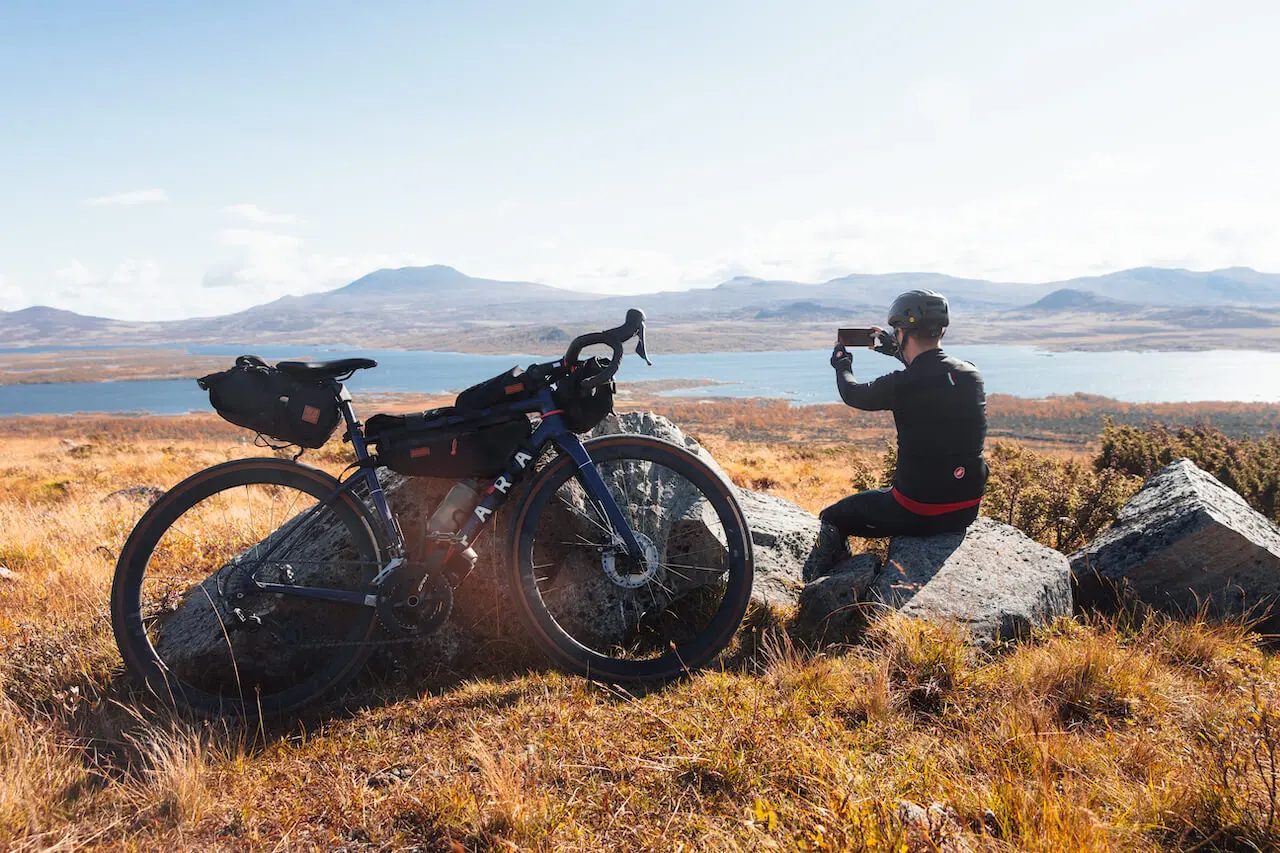
There was a time when bikepacking was an act of faith. You set off with paper maps stuffed in a handlebar bag, a compass dangling from a cord, and a notebook scribbled with distances, campsites, and half-legible directions from locals. Getting lost was part of the story, often the story. A wrong turn meant a long climb back or a night in a ditch, depending on luck and light. But it also meant freedom in its purest form.
Then came the mobile phone.

The Smartphone Revolution
The modern smartphone has transformed bikepacking more than any other single piece of technology. It changed not just how people travel, but who travels. What used to be a niche pursuit for the map-literate and mechanically self-reliant has become accessible to a much wider group of riders.
With GPS mapping apps like Ride with GPS, Komoot, and Google Maps, navigation has gone from uncertain to effortless. A blue dot now tells you exactly where you are, how far to the next turn, and what gradient lies ahead. Gone are the days of trying to triangulate your position between two valleys and a lake that “might be that one on the map.” For many, this has removed the anxiety that used to define multi-day rides, the fear of being truly lost.
Equally transformative is the internet connection itself. With mobile coverage reaching deeper into remote regions each year, cyclists can check weather forecasts, find accommodation, or contact local hosts in minutes. Booking a cabin, rerouting around a storm, or finding a bike shop no longer demands advance planning. Flexibility, once the privilege of those with deep local knowledge, is now standard.
This connectivity also gave rise to an entire ecosystem of digital communities. Cyclists can share routes, reviews, and experiences in real time. Ride with GPS and Strava have become both navigational tools and storytelling platforms, part logbook, part social network. A ride no longer ends at the campsite; it continues online, mapped, annotated, and compared.
The Double-Edged Sword
Yet the convenience comes with trade-offs.
Some riders lament that the spirit of adventure, the uncertainty that made early touring so rewarding, has been diluted. When every route is mapped and every overnight stop reviewed, the element of surprise shrinks. You rarely “discover” a hidden road anymore; someone’s already uploaded it with photos and GPX files.
Then there’s dependence on technology. The more cyclists rely on phones for navigation, the more vulnerable they become to the simplest failure: a flat battery or broken screen. The “what if” that once built resilience, what if you get lost, what if the map’s wrong, has been replaced by the “what if” of modern fragility. No signal, no map, no backup.
And there’s a subtler cost: distraction. The phone, for all its utility, pulls riders out of the landscape. Constant checking of maps, messages, or social feeds can fragment the very sense of immersion that bikepacking once promised. The solitude of the trail competes with the noise of the digital world.

The Next Leap: AI and Wearable Navigation
We now stand at the edge of another shift, one driven by artificial intelligence and wearable technology. The smartphone may soon no longer be the centre of the experience.
Prototypes of AI-powered glasses from companies like Meta, Apple, and smaller cycling tech startups already promise real-time navigation overlays, translating the phone screen into a heads-up display. Imagine riding through a foreign country and seeing turn-by-turn instructions projected subtly onto the road ahead, or an automatic translation of a road sign floating in your field of vision.

AI could also bring smarter route planning. Rather than manually building a GPX route, future systems could learn your riding style, fitness level, and terrain preferences. You might simply say, “I want to ride four hours today, avoid traffic, and sleep by a lake,” and an AI companion would design the route, book a cabin, and even predict energy expenditure based on wind conditions and elevation.
These tools could make bikepacking more accessible and safer, particularly for solo riders, older cyclists, or those new to navigation. Real-time hazard detection, weather warnings, and automatic emergency alerts could prevent countless accidents.

But the same question lingers: how much is too much?
When technology anticipates every need, it risks sterilising the journey. The essence of bikepacking, part adventure, part uncertainty, may fade into a kind of guided simulation. The more seamlessly we integrate AI, the more we risk turning exploration into consumption. The glass between us and the world grows thinner, but it’s still glass.

Finding the Balance
Technology isn’t the enemy of adventure, dependency is. The best riders today aren’t the ones who reject digital tools entirely, nor the ones glued to them, but those who use them consciously. A phone can be a safety net, a journal, and a map, but it shouldn’t dictate every decision.
Perhaps the future lies in hybrid travel using AI for planning and safety, but switching it off when the ride begins. The mobile phone and its descendants can empower us, but they can’t replace the raw encounter with landscape, weather, and self that makes bikepacking meaningful.
The next evolution of technology will likely blur the boundaries between the digital and physical even further. But the true frontier, the real wilderness, will always be internal: the ability to be alone on a road, uncertain but aware, guided by something older and quieter than any device.
Because long before the phone, the map, or even the wheel, there was the human urge to go. And that, at least, remains unchanged.




Leave a Reply