
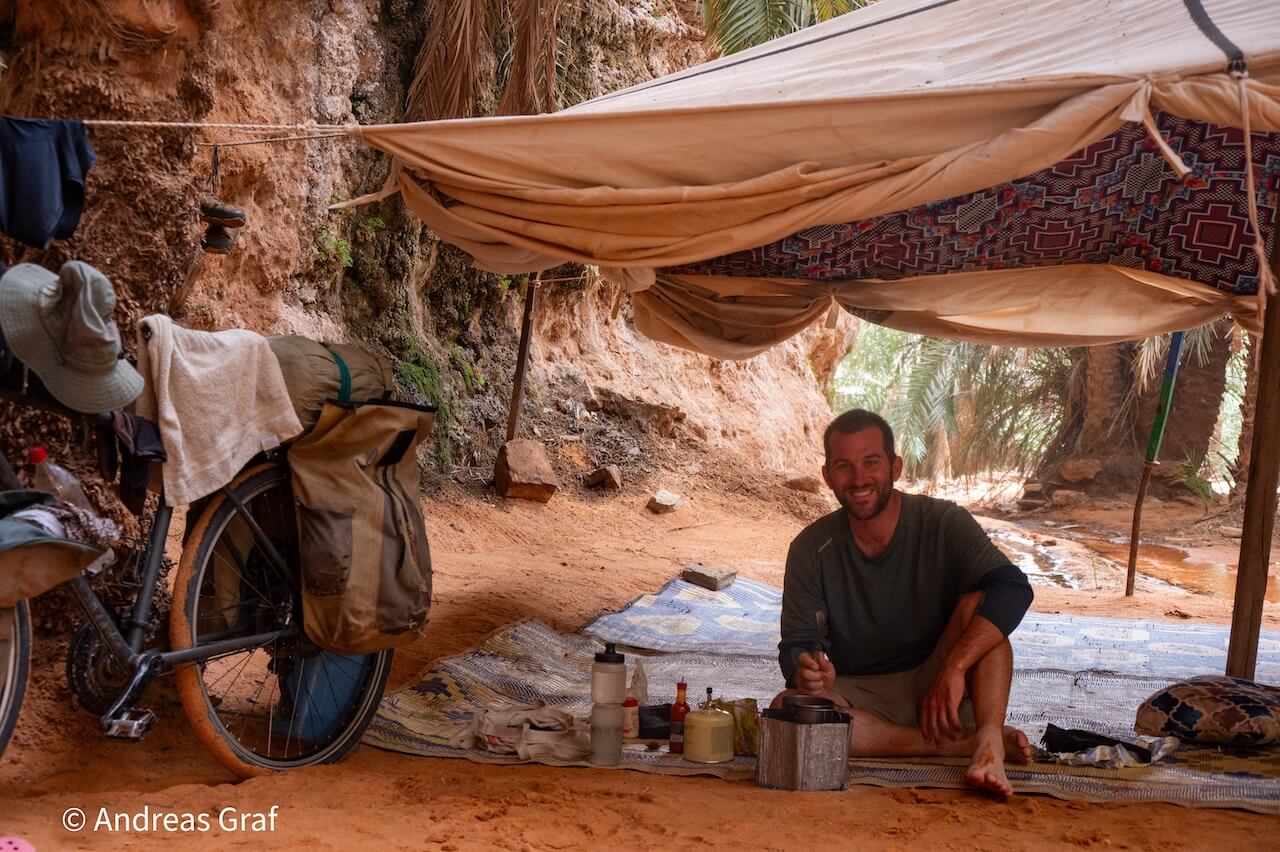
When Andreas left us at the end of Part 1, he was standing on the edge of Asia in Timor-Leste, preparing for what would become one of the most demanding chapters of his expedition. In 2022 he had quietly rolled out of Norway with little more than a bicycle, a tent, and a desire to see where the road might lead. Within two years, he had already crossed Europe, the Middle East, Central Asia, and Southeast Asia, covering tens of thousands of kilometres through deserts, mountains, jungles, and cities.
But now lies one of the toughest places in the world to cycle – the Australian outback. I know from my time living in Australia that the outback is a scary place to be if you’re short on water and supplies, and have no shelter from the unforgiving sun and extreme temperatures. Reading Andreas’s account made me appreciate even more just how difficult long-distance cycling can be. Like any serious adventure, success often depends on preparation, luck, resilience, and a willingness to suffer when conditions turn against you.
So grab a coffee and settle in for the next chapter of this remarkable journey. It’s an account of one man on a bicycle exploring parts of the world that most of us will never see, let alone experience at this pace.
“Heat flairs rose from the dry plains, the sky was an endless mirror of haze and the air felt unbearable to breathe.”
Part 2 Text and photos by Andreas Graf
Following up from a previous article that covered my ride from Norway to Australia, below you can find the account of the continued journey across Oceania, South America and West Africa. In full disclosure, at the time I entered the Australian outback I was far from realising that this journey would eventually lead me around the entire globe. Instead, a year and eight months into my adventure, I lived for the days under a bright sun only, and most ideas around a worldly existence, including having a plan of where to point the compass next, were fleeting at best.
Living such a free life, however, is twofold: Feeling the freedom of the open road and being able to move at my own speed and time came rather easy to me. On the other hand, there is freedom of the spirit, which in my case was not earned without facing plenty of hardship, a good portion of which I’d end up encountering in the weeks ahead. Venturing into Australia’s interior is by no means a small task, particularly so in the middle of the summer. Extreme heat, remoteness, tropical cyclones, floods, bushfires, scarcity of both water and food, river crossings with saltwater crocs, snakes, spiders – the list of things I had to potentially look out for was long.
Yet, more than anything else, I sensed an inexplicable pull to head into the wild unknown all by myself, along with a deep premonition that one way or the other this is where my journey was supposed to lead. It goes to say, at this stage intuition and inner trust certainly were stronger guiding forces than a map or a weather forecast. Finding a sense of calm when faced with a large number of obstacles is a skill any wayfarer must develop at some stage, but perhaps more important is to find acceptance for, and eventually let go of, all the things that are beyond one’s control. Thus, aside from making sure that I carried enough food and water, all else was actually beyond my powers.
In practice that included same rather drastic changes to the setup, including a heavy-duty front rack, as well as leaving behind everything that wasn’t really needed, such as most of my clothes, all winter gear, my sleeping bag and a fair few other items. Strapping large water containers onto the racks, I was able to carry up to 37 liters of water and up to 9 days’ worth of food supplies throughout the most remote sections, pushing the weight of the bicycle to 87kg under full capacity. Lucky for me, there weren’t too many hills to climb throughout central Australia.
And so it came, that only days away from the onset of the rainy season, I left Darwin and was headed south in early December of 2023 with tropical cyclones dwelling in my back and bushfires spanning the horizon ahead. More than anything else, it was a 4,000-kilometer ride into the unknown. A few hundred kilometers further south, I passed the last settlement before the tropical vegetation gave way to a gigantic expanse of bushland and desert. To put things into perspective a little more: if Australia’s Northern Territory was an independent country, it’s population density would be over ten times lower than that of Mongolia – which is widely considered the world’s least densely populated country.
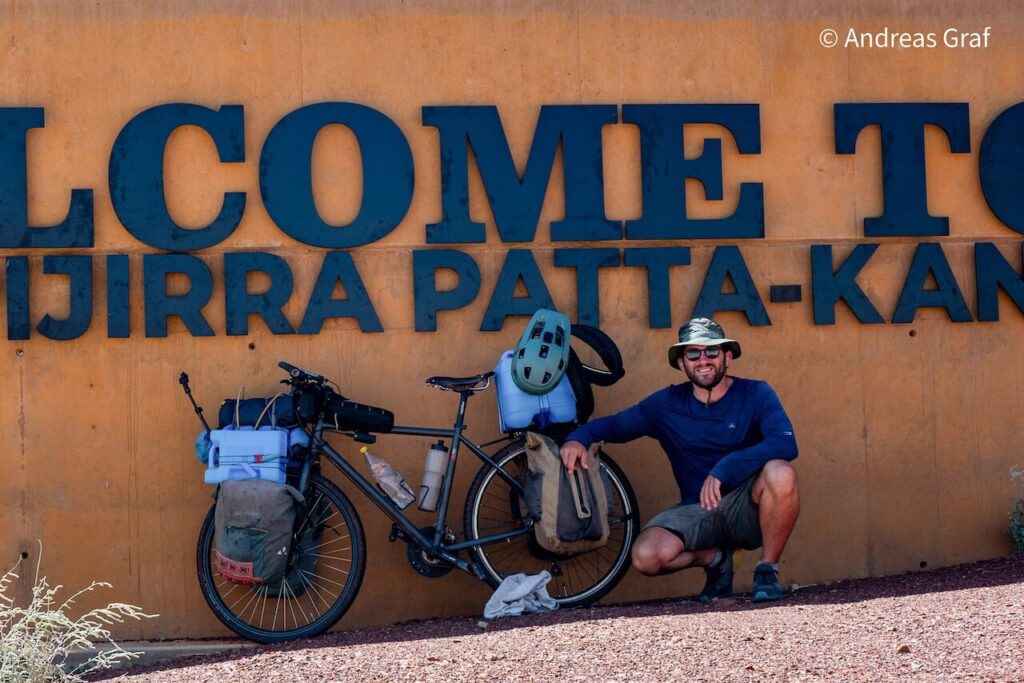
I find it difficult, if not inexplicable, to describe the immense force of the sun and the excruciating swelter that would come my way over the next days and weeks. Heat flairs rose from the dry plains, the sky was an endless mirror of haze and the air felt unbearable to breathe. The strain on my body was immense and with temperatures reaching up to 48 degrees in the shade certainly to no surprise. My days were ruled by the sun, and a never-ending search for water and shade. Beyond my own making, however, the deeper I was headed into the void, whatever physical ailments came my way, they started to grow more distant day after day.
My focus was elsewhere and, in many ways, without realizing it, I had embarked on two different journeys. Across Karlu Karlu, Uluru and the Flinders Ranges, the outback was a track deep into some of humanities oldest history. Many of the encounters with ancestral heritage left me with a sense of awe – a gentle reminder of the insignificance of my own existence, which brought forth days of light-heartedness and for that reason I have been dreaming of going back to the place ever since.
However, the days of the desert were also slow and with thousands of kilometers in-between, on roads with no end in landscapes that looked the same day after day, I often found myself drifting far and beyond. Perhaps it was for the extreme isolation that days of pure bliss were followed by days of melancholy and sadness and robbed of any physical strength to hold on to some old demons, whatever inquiries my soul longed for, they came forth. It was a long way into the darkness that followed and in more than one sense, I had lost my way somewhere out in the middle of the desert.
There is a paradox found in moving forward through the world, while venturing back into the past at the same time. I believe we all have our demons, the darkness we hide from the world, if not even from ourselves, and somewhere out there I came to meet mine. The journey through the void was long and difficult and felt as though it didn’t serve much of a point on many days, but without realising it at the time, some revelations eventually came my way. One thing I knew right there and then, however, was that my adventure was a long way from its end.
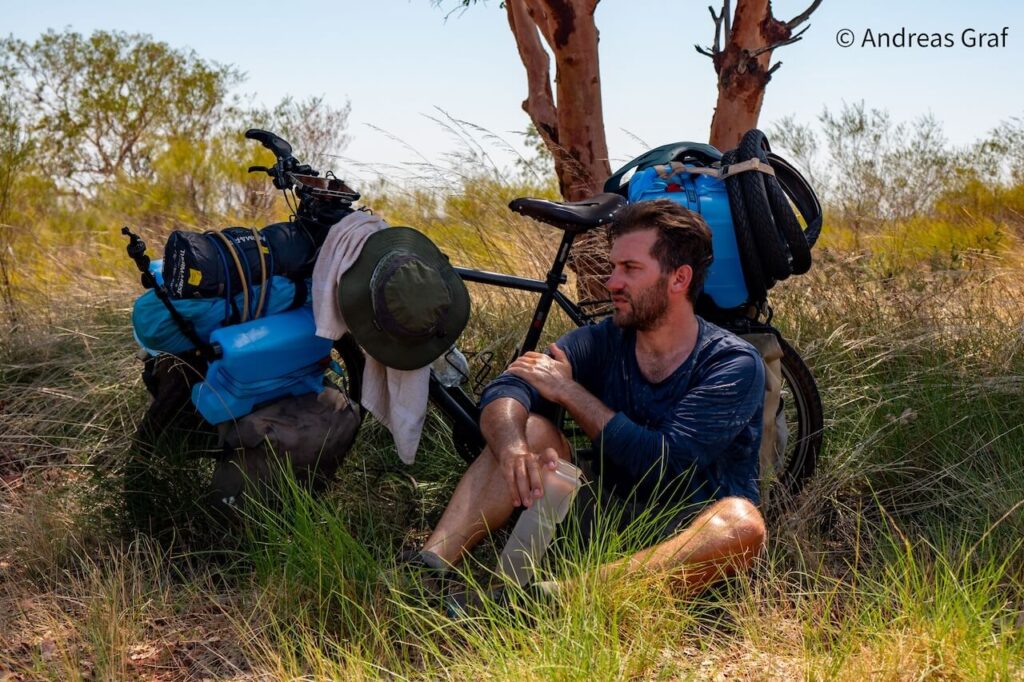
Some 6,000 kilometers across Australia were followed by a period of recovery – for body, mind and spirit. New Zealand came with cooler temperatures as desert landscapes gave way to lush forests and snow-capped peaks. Traversing the hemispheres fell in such order, that a year of non-stop summer would now be followed by a year of non-stop winter and within a month I went from back-to-back 40+ degree-days to my first night with frost on the tent. Mt. Cook, Lake Tekapo and Mt. Taranaki were only few highlights of all the natural beauty found across the archipelago. But more so, I had found a new appreciation for rain, gentle winds, lighter days and well-spirited companionship.
I spent over two months between the islands and over the course of that period new dreams of distant lands had emerged. Across the Pacific, I’d eventually set foot onto the American continent. New cultures, different people, languages, different food: the contrast was stark, but my longing to head into the great unknown, my dream of adventure, was stronger than ever. Over 10,000 kilometers along the spine of the Andes, the longest continuous mountain range in the world, would follow. A long and difficult road awaited and little did I know back then that more trouble was headed my way.
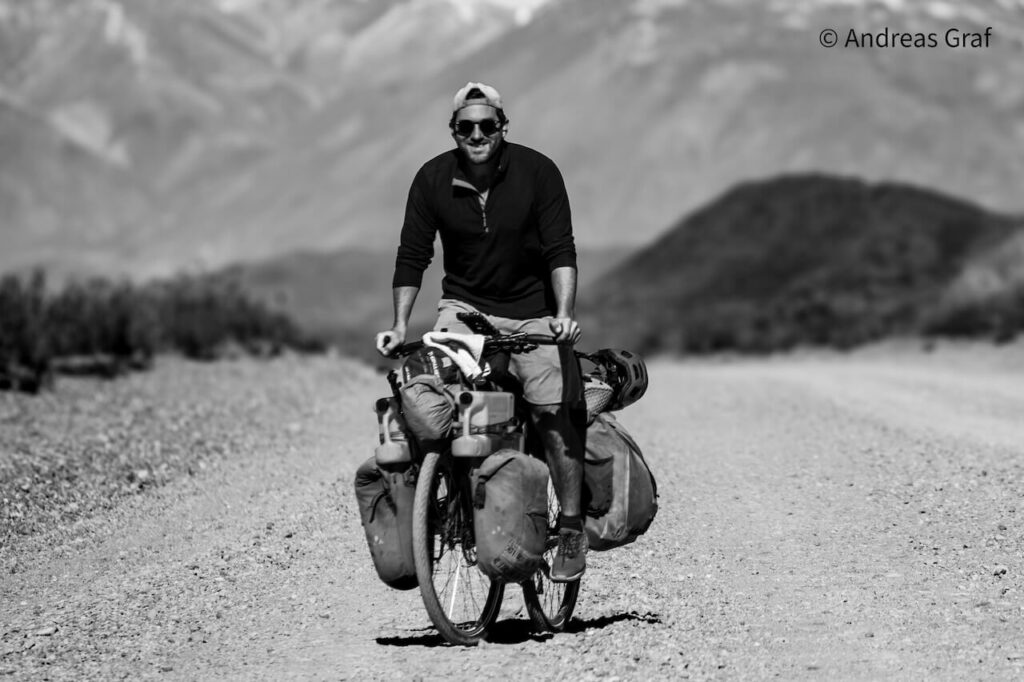
From Chile, I decided to head north via Argentina following a long series of remote mountain tracks. There was literally no grace period with massive climbs into high-altitude that followed on the second day already, passing just south of Aconcagua (6,962masl), the highest peak in the western hemisphere. It didn’t take long for me to fall in love with Argentina and for all the beauty I have gotten to see in this world, mountains like these are found nowhere else. Across rugged terrain and gigantic plateaus, I climbed in solitude, while small villages deep in the mountains came with friendly, welcoming locals.
After two years of heading permanently south across the eastern hemisphere, Latin America came with a significant change of direction as I was northbound for the first time, and in most corners of the world, that means heading against the wind. The Puna de Atacama is the larger area surrounding the Atacama Desert, high up in the mountains between Argentina, Bolivia and Chile, and over the next month I rode along long forgotten mining tracks into altitude. Outside of Antarctica, this is the driest corner on the face of the earth, with areas that have not seen any rain in centuries. It was the first but certainly not the last time that northerly winds hit me with full force. Days upon days of cycling at over 4,800 meters altitude followed and surrounded by 6,000+ meter high stratovolcanoes, I witnessed some of the most beautiful landscapes I had ever seen. It took quite some time to adjust to cycling at altitude, and while I struggled to move forward, there were long stretches of walking that accompanied my route.
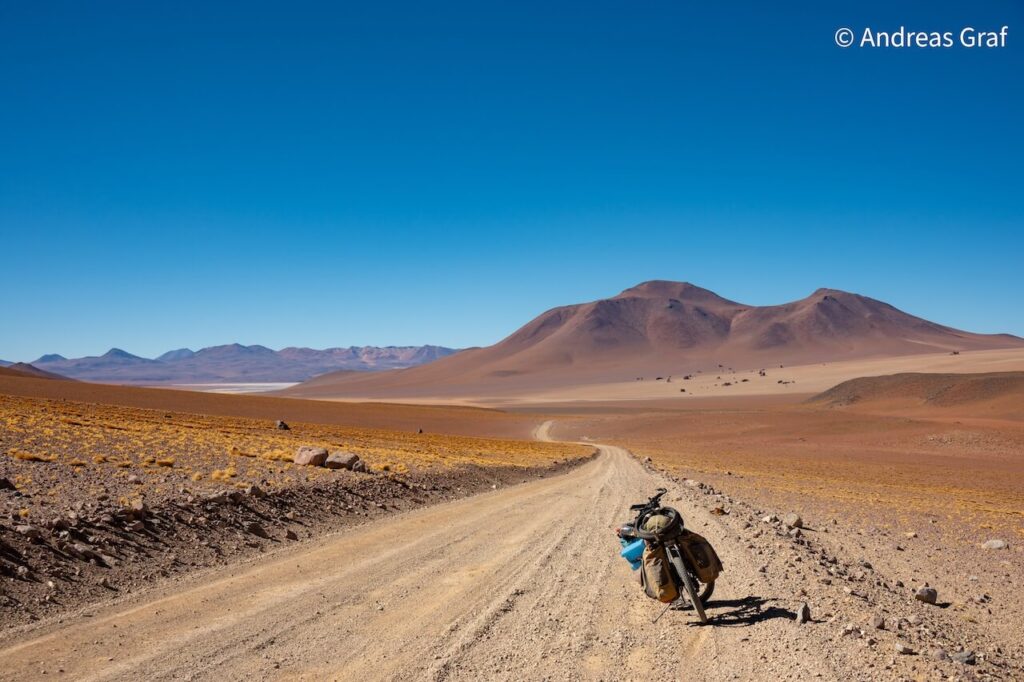
In July of 2024, I re-entered Chile and rode on into Bolivia at Hito Cajon, one of the highest border crossings in the world. The same evening, a 7.4 magnitude earthquake struck with its epicentre just about 40 kilometers south of my position. While no harm came my way it was profound to experience the immense force of nature at play and amid these vast mountain plateaus and stratovolcanoes, I felt incredible vulnerable and fragile.
“The nights here were perhaps the coldest of the entire journey, some dropping to well below -20°C.”
The altiplanos of southern Bolivia were, with few exceptions, void of any life. Across sand and loose gravel, I continued to climb towards the sun, surpassing the 5,000-meter mark on several occasions. The skies were of the deepest blue only, turning almost black straight above, and I couldn’t remember the last time I had seen a cloud. The winds were bone-chilling cold and burnt against the cracked skin on my face and hands, as I was forced to stop every so often to break my constant panting. The most beautiful of days followed, with tracks winding passed colourful lagunas with flamingos searching for food amid the drifting sheets of ice. The nights here were perhaps the coldest of the entire journey, some dropping to well below -20°C. However, there are few places in the world with night skies so clear and watching all the miracles unfold before my eyes every night was worth a frozen toe or two. Days later, I rode across the Salar de Uyuni, the world’s largest salt flat. All alone out in this ivory desert the silence was hauntingly beautiful, and with the black, ever-inexplicable cosmos opening up high above me, there was a special kind of peace that reached my heart.
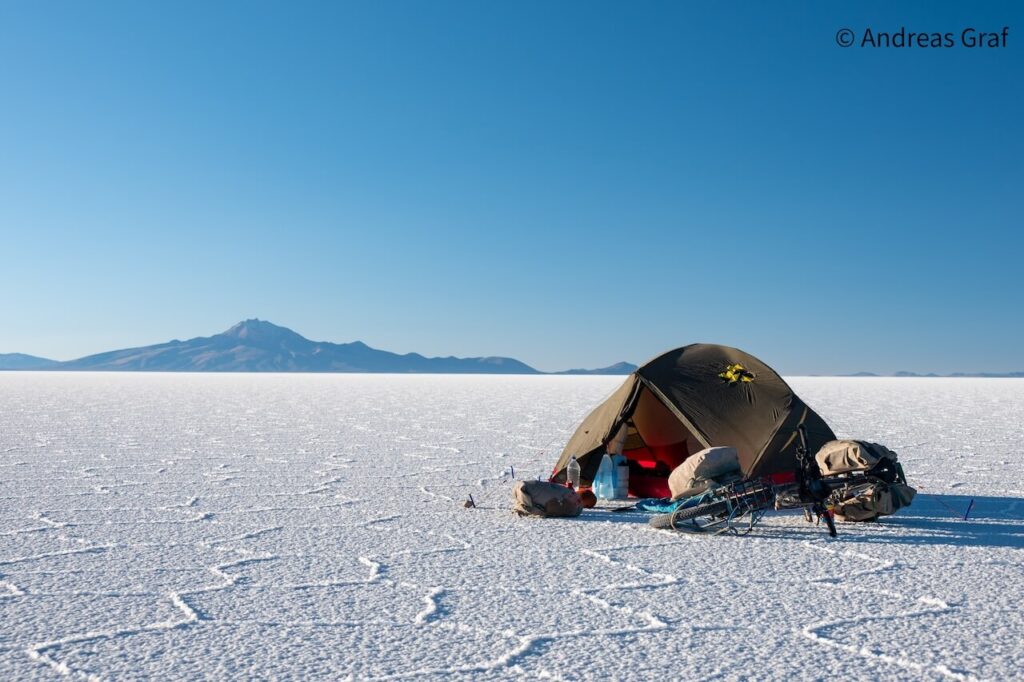
The vastness of the land is striking, and riding across these salt flats the curvature of the planet became visible as mountains grew out of the endlessly flat horizon while I moved forward hour after hour. I felt light-hearted and at ease and everything felt as though it was in natural flow. The locals were wonderfully curious and friendly and, as always, improvised wherever they could to help. On a particular windy night, I ended up on the outskirts of a remote mountain village where a local doctor invited me to stay over. It was only after dinner that I realised staying over literally meant sleeping in her hospital and so I ended up sharing a room with two rather sick, but otherwise charming, elderly ladies. As I parked my bicycle next to a stack of bedpans, laughter emerged in the room and I too cracked, as the irony of that situation came down on all of us. With the years I learnt that compassion comes in many but often rather unexpected ways, and perhaps we all could do better at times making sure we meet it with an open heart when it comes our way.
Via La Paz and Titicaca, I entered Peru mid-August of 2024. Geographically, it is one of the most diverse countries in the world, with sandy deserts stretching along the Pacific Coast, large areas of rainforest extending into the Amazon basin and the towering height of the Peruvian Andes separating the two. While these features make it one of the most bio-diverse countries in the world at the same time, it ever more hit me with great surprise and sadness to witness a great deal of environmental destruction, particularly tied to excessive mining operation in the mountains and plastic pollution. For all its beauty, it made Peru the only country where I wouldn’t filter water directly from streams in certain areas, as my otherwise reliable filtration system was unable to process heavy metals.
“For all the awe I experienced in these mountains, I got soaked pretty good on most days“
Northwest of Abancay, I decided to head down the Peru Great Divide, a long-distance bikepacking route leading over 1,600 kilometers across the Peruvian Andes. I was a little apprehensive to ride deep into the mountains at this stage, as plenty of equipment damages had mounted up over the months prior, including but not limited to, brake failures, rear hub damages, snapped tent poles and gas leaks in the stove. It didn’t take long before things took a turn for the worse and longer repair breaks were needed. I waited out for spare parts from overseas while hiking in the mountains; nevertheless, logistical delays mounted up to weeks and I eventually got to ride the majority of the route in the early days of the rainy season. For all the awe I experienced in these mountains, I got soaked pretty good on most days. I suppose at this stage, however, I took it with a good sense of humour; after all no great adventure ever came without its setbacks.
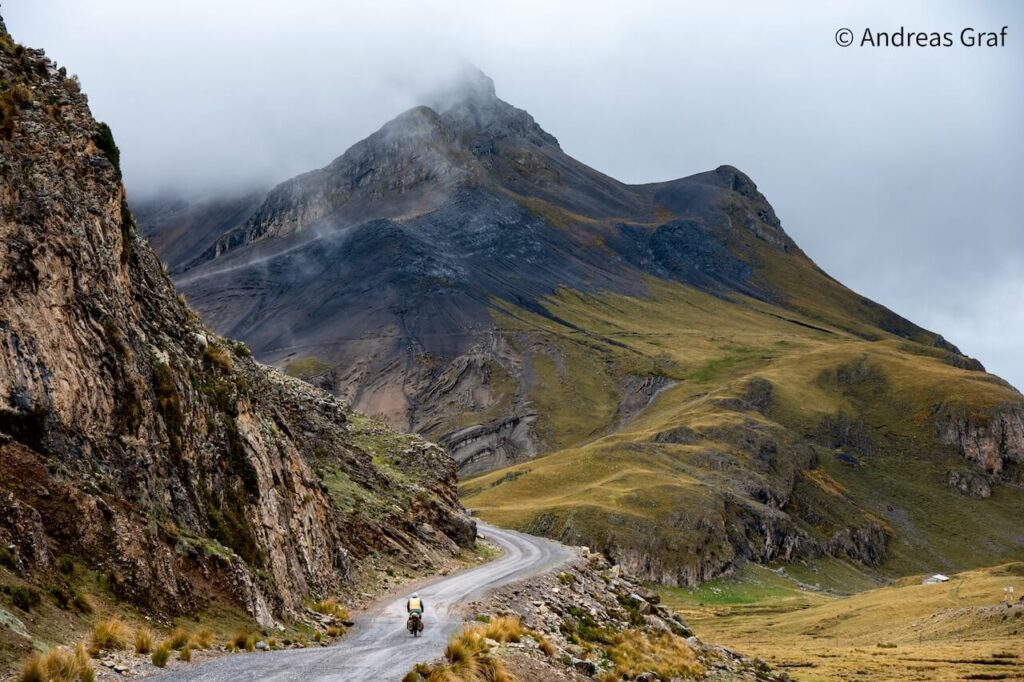
The heavy rains transformed the landscape drastically and the backdrop of thundery clouds and misty mountain tops added a special feel. The Divide is rather heavy on the climbing side with about a dozen passes just below the 5,000-meter mark and deep valleys separating them. Circling around the Cordillera Huayhuash and across the Cordillera Blanca with the mighty Nevado Huascarán at its center was breathtaking and onwards, via Huaraz and the Cañon del Pato, I descended into the Sechura Desert and pushed for the Ecuadorian border.
At the time, Ecuador was under a state of emergency due to gang violence and narcotics trafficking. As that primarily affected coastal regions, I continued hugging high-altitude areas, circled around larger cities and avoided riding into the night. Onwards, that strategy also paid well off as I headed through some corners of southern Columbia. When navigating through conflict areas, my strategy has always been put my trust into local people and so it came that I ended up camping on a few more roofs, in backyards and hidden places than I usually did. Slowly I was making my way north, along endlessly winding roads, passing Chimborazo and Cotopaxi, Ecuador’s highest stratovolcanoes.
In northern part of the country, I re-entered the tropics and the landscape slowly changed from mountains into jungle. The Trampoline del Muerto was my first stop in Colombia after crossing a more than shady border a little further south. A windy jungle road leading through former militia territory, it was a beautiful ride, yet more than once I was warned to stay alert, particularly in remote sections.
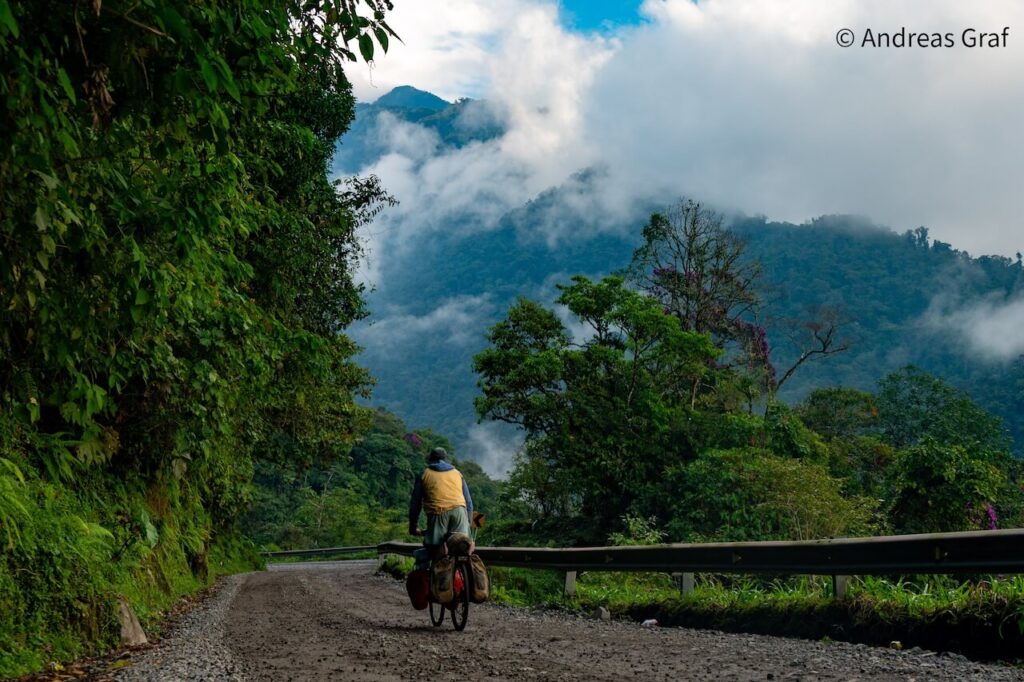
Geographically, central Colombia comes with three parallel mountain ranges, and avoiding larger cities like Cali, I cycled through the eastern valley, before crossing over halfway through near Ibagué. Slowly, I was bound for the northern end of the Andes and had set my eyes on West Africa already, as seemingly out of nowhere everything came different. The combination of an oil spill and a pothole on the second-last descent towards Medellin sealed my fate, and aside from plenty of cuts and bruises after flying over the handlebar, I ended up with a complex radius fracture that required immediate surgery, eventually leaving me with an implant and a fair few screws holding my wrist together.
I felt devastated, ever more so as I was eventually forced to head to Europe to continue treatment. Even before the surgery I always knew I wanted to return, but while my bicycle and equipment had remained behind and were ready to keep going, self-doubt emerged. Physical injuries and a long recovery aside, it was a period of introspection, mostly for questioning my own motivations. In the end, I came to remember why this entire adventure commenced to begin with: I wanted to experience life on my own terms, without any backup-plans and with everything that, for better or worse, came my way. Agency, after all, is found in not letting circumstance define the outcome, and more than anything else I wanted to write the end to my own story.
It was therefore that a little over two months after the surgery, my bicycle and I reunited in Dakar, Senegal – the place I was supposed to arrive to from Colombia prior to the accident. Despite a few minor aches during the first few days, I quickly came to feel at ease once more while I rode south towards Gambia. Africa held a special place in my heart ever since I backpacked large parts of the continent almost a decade earlier. By all means, it is intense, relentless, and there is a rhythm to life that is so invigorating, it made me forget whatever ailments I had the months prior within days.
A brief stint around the Gambia river later, I turned directions to head north and eventually set my eyes on the world’s largest desert. Anyone who has ever ventured into the Sahara might have quickly come to realize that winds are the dominating force in this part of the world, even though the heat was unbearable on most days. For the extreme temperature difference of the cool Atlantic and the immense heat of the Sahara’s interior, the prevailing trade winds are southbound, and hence I was headed into the wind for the next 3,500 kilometers. As fate had it, I once more was desert-bound in the middle of the summer, and thus it came, that in mid-June of 2025 I crossed the Mauritania border and entered a world of sand-dunes, nomadic wanderers and mystical tales of long-lost times.
Alike Australia, I once more felt the strong grip the desert had on me, and instead of staying northbound and taking the quick route, I ventured west towards Mali and Algeria. It was a long, lone and laden route up onto the Adrar plateau, and one that with time would eventually proof too difficult. Across heavily corrugated and sandy tracks I managed to reach Chinguetti, an ancient settlement along old trans-Saharan trading routes, before I attempted to continue to ride towards Ouadane, one of the world’s most desolate human settlements. With no shelter to be found to escape the hostile environment I cycled on, yet the following day temperatures rose to a mortal 51°C in the shade, and even though my body did hold on much longer than I thought possible, the desert eventually broke me.
Throughout my time in Mauritania, I never saw daytime temperatures below 40 degrees, except in the port city of Nouadhibou at the Western Sahara border. Upon cycling down from Adrar after a recovery period, things therefore didn’t get much easier, but at least along the coast shelter and water were easier to come by, and eventually Nouadhibou made for a nice place to rest.
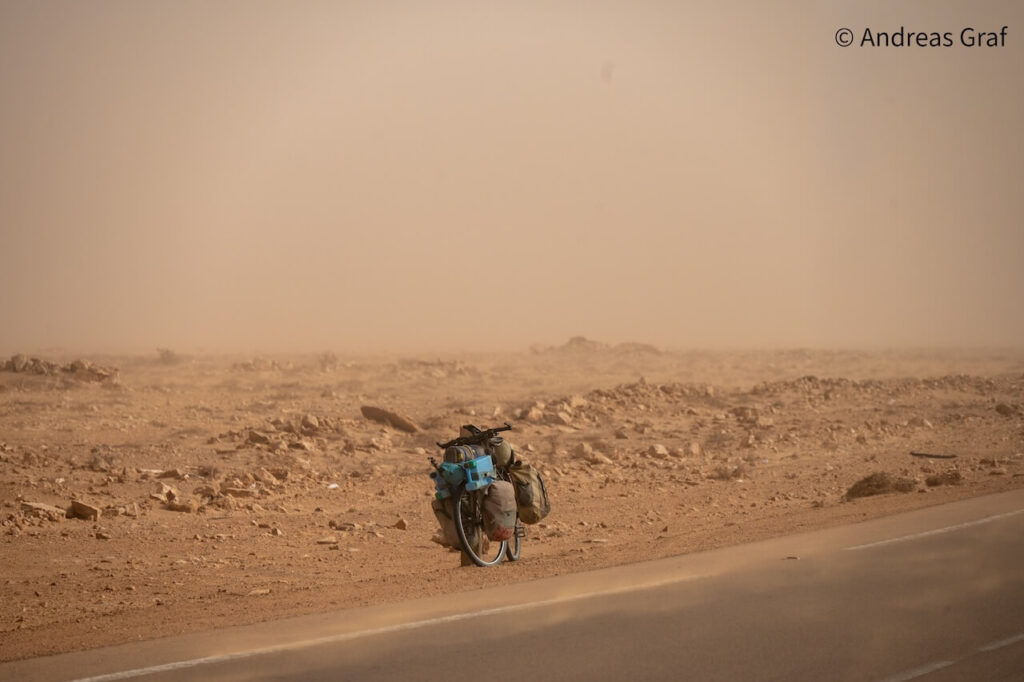
However hostile nature in this corner of the world may be, there is immense beauty to be found, and more than anything else I was fascinated by nomads who have been home in the Sahara for many centuries. Yet, while things appear calm on the outside, entering the territory of the Western Sahara came with new realisations, many of which were difficult to endure. A conflict region for a long five decades now, the area is not only under dispute with a large military presence found along its borders, but it is one of the most heavily mined territories in the world. Add one of the world’s largest refugee camps across the Algerian border in Tindouf, and a great many people trying to reach the Canary Islands by boat from the coast further north into the mix, and suddenly cycling quickly was replaced by a lived experience of geopolitical conflict.
That humankind never seems to be able to learn from its own history probably goes beyond the scope of this article, but perhaps I could say that even in conflict and war zones, for all the differences we may have, I had the chance to meet compassionate and kind people, whose idea of life is all but the same from the one you and I have. During the second and worst of three sandstorms I battled through, an ambulance station in the middle of nowhere became my own refugee camp. While the walls rattled against the wind and sand seeped through the cracks, I shared a meal and laughter and a moment of solace with three strangers – all in the middle of a conflict zone in the world’s largest desert under a summer’s blaze. I don’t know about you, but as far as I go, all there is to understand about what it means to be human was found right there and then.

On a more spiritual level, the desert had a way around patience that I haven’t found anywhere else. On many days, the harder I tried to move forward, the more persistent the winds seemed to push against me; a fight that I lost time and time again. Surrender, ultimately, is a virtue the desert teaches with fierce relentlessness and leaving the Western Sahara for the Moroccan Atlas Mountains at last, I was left with a humility I haven’t felt in a long time.
Mid-August of 2025, I rode across the High-Atlas, following old Berber tracks into deep green valleys that contrasted the otherwise lifeless desert landscape. It was amazing to weave through these rugged landscapes and beautiful sceneries unfolded before my eyes day after day. Slowly, I sensed a change in winds and the smell of pine trees from the Mediterranean came my way. For the most part, I felt melancholic but also anxious as I saw the rock of Gibraltar appearing in the distance. For long I had known that this adventure changed me, but I had yet to find out to exactly what extent. Mid-September of 2025, I touched down in Spain, feeling overwhelmed as to how estrange I felt in a corner of the world I had known most of my life.
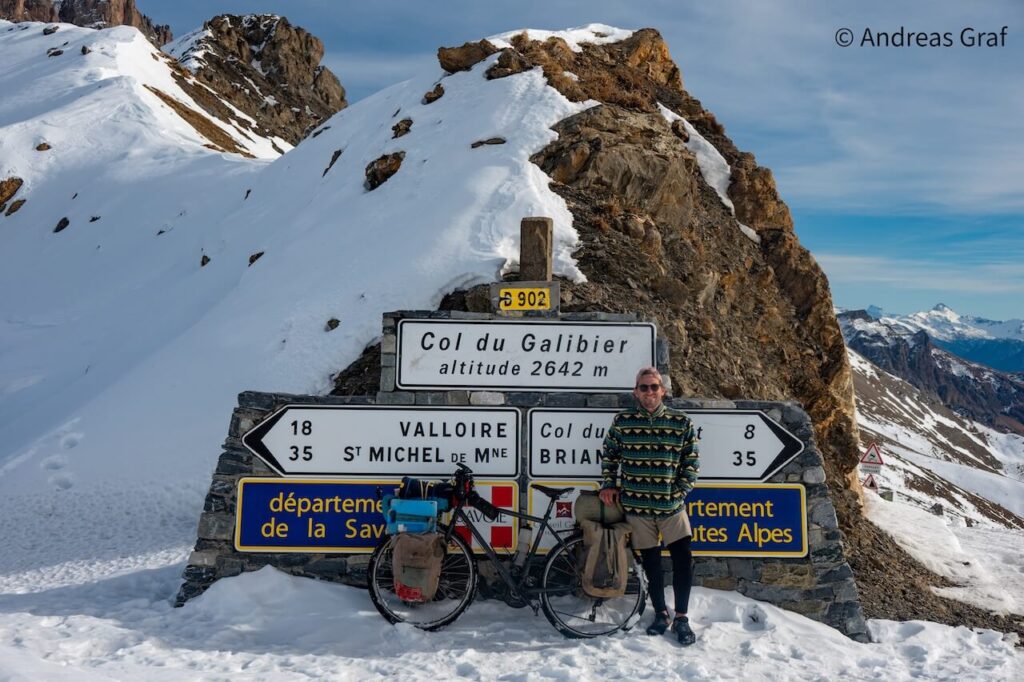
“By the time I reached Denmark, the days were so short that I cycled into the dark day after day while my bike slowly fell into pieces. “
For my love of mountains, I took the longer route back to Norway, traversing the Portuguese backcountry, the length of the Pyrenees and the French Alps before winter eventually settled on me once more. By the time I reached Denmark, the days were so short that I cycled into the dark day after day while my bike slowly fell into pieces. Via the south coast of Sweden I pushed north through the cold and the rain, before long, 1338 days after leaving Norway, I found myself back just in time for Christmas 2025. Having pedalled over 55,000 kilometers around the world and accumulating way over half a million meters in altitude, the original idea of cycling from Norway to India had turned into something way greater than I ever imagined.
It won’t lie in saying that the chapter that follows such a long journey is far from being easy and frankly one I am still navigating. It was impossible to observe all the change that came my way as I went through it and hence a great many observations continue to unfold as I find myself in familiar territory. The journey I once embarked upon changed drastically with the years and eventually cycling became a mere vehicle for a different kind of adventure.
Thanks for reading this far and I hope you enjoyed the ride! Should you have questions or simply want to say hello, I always take the time to answer my messages personally. email: [email protected]
More information found at www.andreasgraf.co or @andreas_pa_tur






Leave a Reply